Upcoming documentary
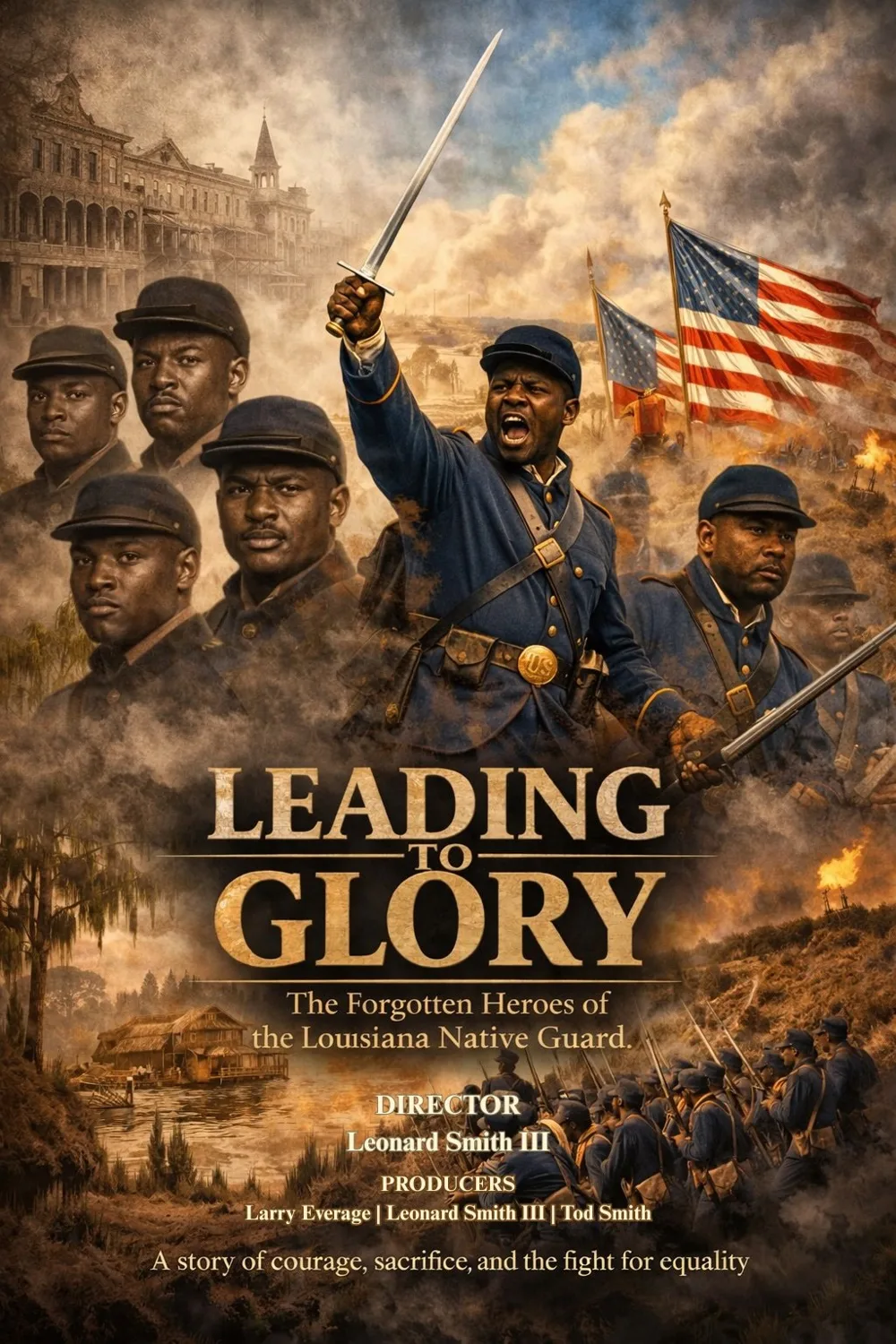
Leading to Glory
Five Louisiana men who volunteered to fight for the freedom they sought and cherished, and the Louisiana Native Guard regiments they served in.
Corrected and updated. An earlier version of this post said the Second Native Guard formed after the Emancipation Proclamation, placed a battle at “Fort Hudson,” and described the 1861 Native Guard as a Union unit. The history below has been corrected against the sources listed at the end.
Leading to Glory is the story of five Louisiana men who volunteered to fight for the freedom they sought and cherished. Their stories have often been forgotten, shared only by word of mouth or hidden deep within public and private archives, yet their impact endures to this day.
A militia the Confederacy never used
In April 1861, at a public meeting of the free colored population of New Orleans, free men of color organized a militia known as the Native Guards. Its officers were commissioned by Louisiana’s Confederate governor, Thomas O. Moore (General Orders No. 63, American Battlefield Trust). The Confederacy had no intention of using these men in its army (64 Parishes), and as Union forces closed in on New Orleans in April 1862, the Native Guards were ordered to disband (American Battlefield Trust).
Three Union regiments
After the Union captured New Orleans, former Native Guard officers offered their services to General Benjamin Butler. His General Orders No. 63, issued August 22, 1862, allowed them to enlist in the Union Army (American Battlefield Trust).
The 1st Louisiana Native Guard was mustered into service on September 27, 1862, the first Black regiment to join the Union Army. The 2nd was mustered on October 12, 1862, and the 3rd on November 24, 1862 (National Park Service). All three were in service before the Emancipation Proclamation took effect on January 1, 1863.
The regiments included free men of color, among them P.B.S. Pinchback, later the South’s only African American governor during Reconstruction, but formerly enslaved men soon made up the majority of the troops (64 Parishes). The 1st Louisiana Native Guard had Black line officers; Captain André Cailloux was one of 19 Black officers commissioned in the regiment (American Battlefield Trust).
Port Hudson
On May 27, 1863, the 1st and 3rd Louisiana Native Guards took part in the Union assault on Port Hudson, the Confederate stronghold on the Mississippi River. It was the first time Black troops were used in a general engagement (National Park Service), three months before the 54th Massachusetts charged Battery Wagner (64 Parishes). During the siege, the 1st Louisiana Native Guard lost 2 officers and 32 men killed, and 3 officers and 92 men wounded (National Park Service).
Sources
- American Battlefield Trust, “Department of the Gulf: General Order No. 63” (transcription of the 1862 order)
- American Battlefield Trust, “Andre Cailloux”
- National Park Service, Richmond National Battlefield Park, “Background of the USCT’s”
- 64 Parishes, “Civil War Louisiana”
- LSU Libraries, “Free People of Color in Louisiana”
- Library of Congress, “African American Military Service Timeline”